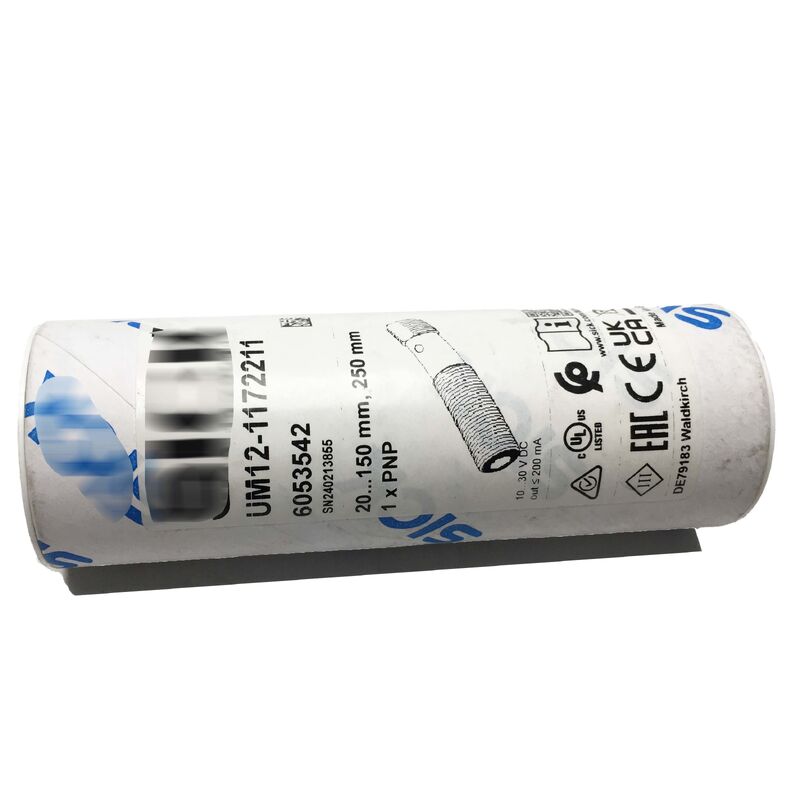
SICK UM12-1172211 | Ultrasone Afstandssensor — M12 Schroefdraad Vat, 20–150mm, PNP NO, 10–30V DC, 30Hz, IP65/67
Overzicht
De SICK UM12-1172211 brengt SICK's bewezen ultrasone sensortechnologie in een M12 schroefdraad vat — een vormfactor die lange tijd werd gedomineerd door inductieve en capacitieve naderingsschakelaars.
Met een lichaamslengte van 55,1 mm is dit werkelijk compact voor een ultrasone unit, en de M12 × 1 schroefdraad betekent dat hij direct in dezelfde 12 mm installatiegaten past die worden gebruikt voor conventionele vat naderingsschakelaars, zonder adapters of speciale beugels.
Het werkingsbereik van 20–150 mm dekt de detectietaken op korte afstand waarvoor ultrasone sensoren steeds vaker de voorkeur krijgen: niveau detectie in kleine containers, aanwezigheid van onderdelen op smalle transportband sleuven, object detectie ongeacht het oppervlaktemateriaal of de kleur.
Dat laatste punt is de moeite waard om te benadrukken — waar een inductieve sensor alleen reageert op metaal en een foto-elektrische sensor kan worden misleid door transparante of spiegelende objecten, reflecteert de UM12 geluid van vrijwel alles wat vast of vloeibaar is binnen zijn straal, waardoor materiaal onafhankelijkheid een echt toepassingsvoordeel is in plaats van een marketingclaim.
Met een zendfrequentie van 380 kHz werkt de UM12 aan de hoge kant van het industriële ultrasone sensoren frequentiebereik. Hogere frequentie betekent een smallere geluidsbundel en fijnere ruimtelijke resolutie — de meetresolutie van 0,069 mm weerspiegelt dit.
Schakelfrequentie van 30 Hz is geschikt voor de meeste detectie- en niveaubewakingstaken op productiemachines, hoewel toepassingen die detectie van snel passerende objecten vereisen dit moeten controleren tegen de verwachte cyclussnelheid.
SICK's temperatuurcompensatie loopt intern en continu, waardoor de ±1% nauwkeurigheidsspecificatie geldig blijft over het volledige −25°C tot +70°C werkingsbereik zonder dat veldkalibratie nodig is wanneer de omgevingstemperatuur verandert.
Dit is belangrijk op productievloeren waar de omgevingstemperatuur aanzienlijk kan schommelen tussen nachtdienst- en piekproductieomstandigheden.
Belangrijkste Specificaties
| Parameter |
Waarde |
| Detectiebereik |
20–150mm |
| Voedingsspanning |
10–30V DC |
| Uitgangstype |
PNP NO (digitale schakeling) |
| Uitgangsstroom |
≤200mA |
| Schakelfrequentie |
30 Hz |
| Responstijd |
24ms |
| Resolutie |
0.069mm |
| Nauwkeurigheid |
±1% (temp. gecompenseerd) |
| Herhaalbaarheid |
±0.15% |
| Hysteresis |
3mm |
| Ultrasone Frequentie |
380 kHz |
| Behuizingsschroefdraad |
M12 × 1 |
| Lichaamslengte |
55.1mm |
| Aansluiting |
4-pins M12 mannelijk |
| IP-classificatie |
IP65 / IP67 |
| Bedrijfstemperatuur |
−25°C tot +70°C |
| LED Indicatoren |
2× |
Ultrasoon vs. Conventionele Naderingsschakelaars — Waar de UM12 Past
Inductieve en capacitieve sensoren hebben M12 vat naderingsschakeling gedomineerd vanwege hun eenvoud en lage kosten. De keerzijde is specificiteit: inductieve sensoren vereisen metalen doelen, capacitieve sensoren worden beïnvloed door vochtigheid en nabije materialen.
De UM12 voegt ultrasone meting toe aan het M12 formaat zonder deze beperkingen — de sensor meet de vliegtijd van de gereflecteerde geluidsgolf, wat even goed werkt vanaf glas, rubber, schuim, granulaten of vloeibare oppervlakken.
Achtergrondonderdrukking is ingebouwd in de UM12 via de 150 mm schakelpuntinstelling van de sensor: objecten buiten de ingestelde drempel activeren de uitgang niet, zelfs als ze binnen het fysieke bereik van de geluidsbundel vallen, waardoor de sensor een transportband of montageoppervlak dat achter het doelobject ligt, kan negeren.
Deze achtergrondonderdrukking is inherent aan de op afstand gebaseerde schakellogica in plaats van een aparte functie om te configureren.
IP65/67 en Installatie Overwegingen
Dubbel geclassificeerd IP65 en IP67 betekent dat de UM12 zowel waterstralen (IP65) als korte onderdompeling tot 1 m diepte (IP67) aankan.
De vernikkelde messing behuizing is bestand tegen de reinigingschemicaliën die veel voorkomen in de voedselverwerkende en farmaceutische industrie, en het PUR-schuim / glas-epoxy transduceroppervlak is bestand tegen de vochtigheid en condensatie die typisch zijn voor gekoelde productieruimtes.
De beveiliging tegen omgekeerde polariteit en kortsluiting/overbelasting beschermen de uitgangstransistor tegen bedradingsfouten tijdens installatie, waardoor de veelvoorkomende faalmodus van een verkeerd aangesloten sensor bij een paneelwissel wordt voorkomen.
Veelgestelde Vragen
V1: Kan de UM12-1172211 transparante objecten zoals glazen flessen of doorzichtige folie detecteren?
Ja. Ultrasone sensoren detecteren via gereflecteerd geluid in plaats van licht, dus transparantie is geen factor.
Glas, doorzichtige PET-flessen, polyethyleenfolie en vloeibare oppervlakken reflecteren allemaal ultrasone pulsen betrouwbaar, mits het object binnen het 20–150 mm werkingsbereik valt en een oppervlak heeft dat groot genoeg is ten opzichte van de bundeldiameter op die afstand.
Dit is een van de belangrijkste redenen waarom ultrasone sensoren worden gespecificeerd voor de detectie van glazen containers op vullijnen waar foto-elektrische sensoren onbetrouwbare resultaten opleveren.
V2: Wat is de minimale detectieafstand, en wat gebeurt er als een object dichterbij is dan 20 mm?
De 20 mm minimum weerspiegelt de dode zone van de sensor — de afstand voor het transduceroppervlak waar de uitgezonden puls nog niet volledig is opgelost voordat de sensor begint te luisteren naar de echo.
Objecten dichterbij dan 20 mm worden niet betrouwbaar gedetecteerd; de sensor schakelt mogelijk helemaal niet of produceert een grillige output in deze zone.
Voor toepassingen waarbij het doelobject regelmatig dichterbij komt dan 20 mm, moet een ander sensorbereik of detectieprincipe worden gekozen.
V3: Hoe werkt de temperatuurcompensatie, en is deze altijd actief?
De geluidssnelheid in lucht verandert met ongeveer 0,17% per kelvin temperatuurverandering.
Zonder compensatie zou een sensor gekalibreerd op 20°C zinvolle afstands-fouten opleveren bij 5°C of 40°C.
Het interne temperatuurcompensatiecircuit van de UM12 past continu de vliegtijd-berekening aan op basis van een interne temperatuurmeting, waardoor de ±1% nauwkeurigheid geldig blijft over het volledige −25°C tot +70°C bereik.
Deze compensatie is altijd actief en vereist geen gebruikersconfiguratie.
V4: Wat geeft het 2-LED indicatiesysteem aan tijdens normale werking?
De twee LED's geven de bedrijfsstatus en de uitgangstoestand aan. Meestal bevestigt één LED dat de stroom is ingeschakeld en de normale werking, terwijl de tweede LED van toestand verandert wanneer de schakeluitgang wordt geactiveerd — wat bevestigt dat een object wordt gedetecteerd binnen de ingestelde schakelafstand.
Deze dubbele LED-opstelling stelt de installateur in staat om de detectie te verifiëren zonder een extern testinstrument, wat nuttig is tijdens de ingebruikname wanneer de sensor wordt gepositioneerd om het juiste schakelpunt voor de toepassing te bereiken.
V5: De UM12-1172211 heeft een 4-pins M12 connector — wat is de standaard pinbezetting?
Op een PNP 4-pins M12 sensor volgt de standaard pinbezetting de industriële conventie: Pin 1 = +V voeding (bruin), Pin 3 = 0V/GND (blauw), Pin 4 = PNP schakeluitgang (zwart). Pin 2 is niet aangesloten op de versie met één uitgang.
De 4-pins M12 mannelijke connector op de sensor past op een standaard 4-pins M12 vrouwelijke socket kabel, die breed verkrijgbaar is als een kant-en-klare assemblage in verschillende lengtes bij de meeste leveranciers van industriële automatisering.



 Uw bericht moet tussen de 20-3.000 tekens bevatten!